 Save to Pinterest
 The first time I tasted lahmacun, I was standing in a cramped kitchen in Istanbul, watching my friend Aylin work the dough with such ease that it seemed to obey her hands like muscle memory. She'd roll each circle so thin I could almost see light through it, then top it with a meat mixture that smelled like cumin, paprika, and something I couldn't quite name—maybe the way her grandmother had done it for forty years. Years later, I'd recreate that same magic in my own kitchen, and now whenever I make lahmacun, that moment comes rushing back: the steam rising from the oven, the sizzle of the hot stone, and the pure satisfaction of biting into something that tastes like a memory.
I remember bringing a batch of these to a potluck on a cool autumn evening, nervous that no one would understand what they were. Instead, people came back for seconds, thirds, wrapping them around lemon and fresh herbs, asking for the recipe. One friend even said it transported her back to a trip to Turkey she'd taken ten years earlier. That's when I realized lahmacun isn't just food—it's a way to share a place, a culture, a feeling.
Ingredients
- All-purpose flour (300 g): Use a good quality flour that can develop gluten structure; it'll give you that perfect tender-yet-chewy base.
- Warm water (180 ml): Temperature matters more than you'd think—too hot kills the yeast, too cold and it won't wake up.
- Instant yeast (1 tsp): Don't skip the rising time even if you're in a hurry; those 30 minutes are when the magic happens.
- Ground lamb or beef (300 g): Lamb is traditional and has more character, but beef works beautifully if that's what you have.
- Onion, garlic, tomato, red bell pepper (finely chopped): The finer you chop, the more evenly the topping spreads and the better it binds together.
- Tomato paste (2 tbsp): This is your umami anchor; don't dilute it, let it sit in the meat mixture and deepen the flavor.
- Fresh parsley (2 tbsp): Add it at the end so it keeps its brightness; a tired handful won't do the dish justice.
- Cumin and paprika (1 tsp each): Toast these in your head as warm spices—they're what make lahmacun taste distinctly Turkish.
- Chili flakes (optional, 1/2 tsp): Just enough for a whisper of heat, unless you want people reaching for water.
- Olive oil (2 tbsp for topping): This helps everything cook evenly and keeps the meat from drying out on the hot stone.
- Lemon wedges and fresh herbs for serving: These aren't garnishes; they're essential partners that brighten every bite.
Tired of Takeout? 🥡
Get 10 meals you can make faster than delivery arrives. Seriously.
One email. No spam. Unsubscribe anytime.
Instructions
- Make the dough:
- Dissolve the yeast in warm water with a pinch of sugar and let it sit for a minute until it foams—that's your sign it's alive and ready to work. Mix flour and salt in a bowl, pour in the yeast water and olive oil, and stir until you have a shaggy dough, then knead it for about 5 to 7 minutes until it's smooth and elastic, like a soft earlobe.
- Let it rise:
- Cover the dough with a damp cloth and leave it in a warm corner of your kitchen for 30 minutes or until it's doubled in size; you'll know it's ready when a gentle poke leaves a small indent that doesn't spring back.
- Build the meat topping:
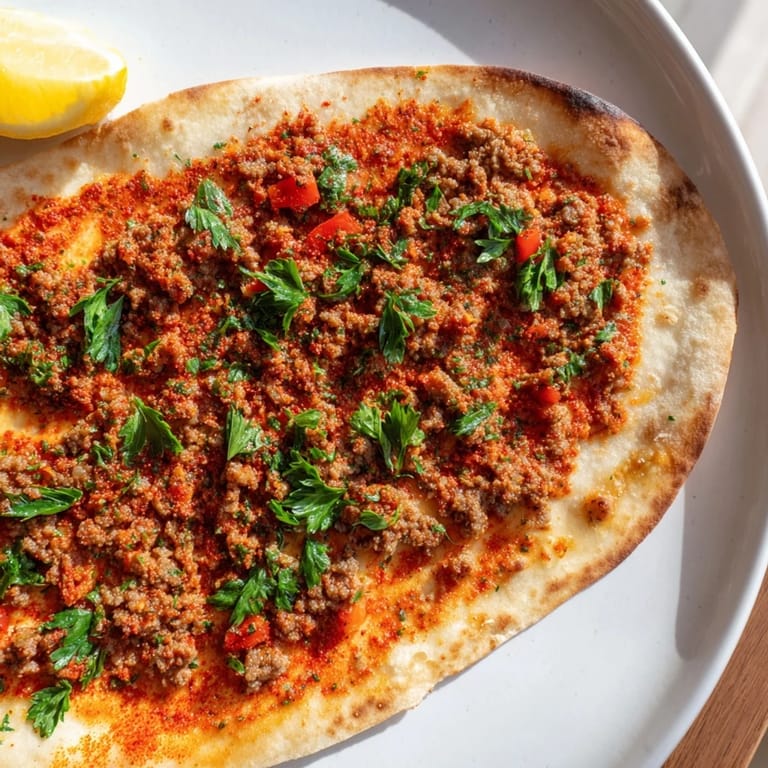
- Combine the ground meat, finely chopped vegetables, tomato paste, and spices in a bowl, mixing with your hands until everything is well distributed and the mixture feels cohesive and fragrant.
- Heat your oven:
- Crank it to 250°C (480°F) or as high as your oven goes, and place a pizza stone or baking tray inside to get screaming hot—this is what gives you that crispy bottom.
- Shape and top:
- Divide the dough into 8 pieces, roll each one very thin (you want to see your hand through it), then spread the meat mixture in a thin, even layer, leaving a small border around the edge.
- Bake until crispy:
- Slide each lahmacun onto the hot stone and bake for 6 to 8 minutes until the edges are golden and crispy and the meat is cooked through; you might hear a slight sizzle, which is exactly what you want to hear.
- Finish and serve:
- Pull them straight from the oven, scatter fresh parsley on top, squeeze lemon juice all over, and optionally add some sliced onions and sumac for tang and color.
 Save to Pinterest
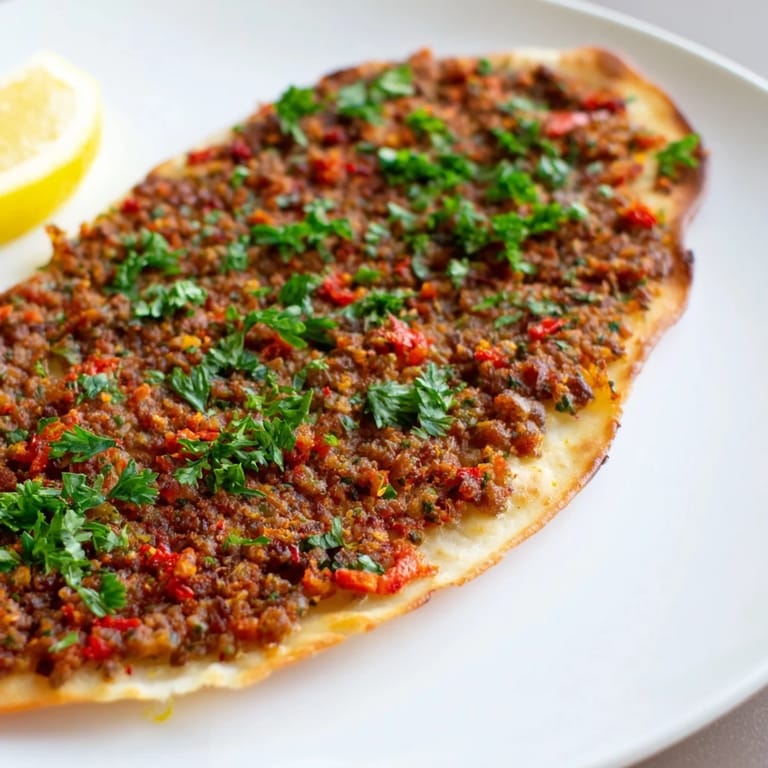
 There's something almost ceremonial about serving lahmacun fresh from the oven, watching someone take that first bite with lemon juice running down their hands, their eyes lighting up when they taste what you've made. In that moment, you're not just feeding someone—you're giving them a small piece of Turkey and a memory they'll carry.
Rolling the Dough Thin
The thinness of your lahmacun dough is the secret to its character. When I first made these, I was too cautious with my rolling pin, ending up with thick, bread-like rounds that felt heavy instead of crispy. A friend gently took the rolling pin from me and showed me that you need to stretch the dough almost to the point of fear, getting it so thin it's almost translucent. Now I use the back of my hands as much as the pin, gently lifting and stretching from the center outward, letting gravity help me. The result is a base that crisps up in minutes and holds the meat topping like a delicate canvas rather than a thick foundation.
The Meat Topping Secrets
This isn't a sauce—it's a composed mixture where every element stays distinct while working in harmony. When I started making lahmacun regularly, I realized that how finely you dice the vegetables matters enormously. Large chunks meant uneven cooking and a topping that sometimes slid off the thin dough, while finely minced vegetables created a cohesive layer that stuck to the base and cooked evenly throughout. The oil is equally important because it helps everything bind together and prevents the topping from drying out during those crucial minutes in the screaming-hot oven.
Serving and Variations
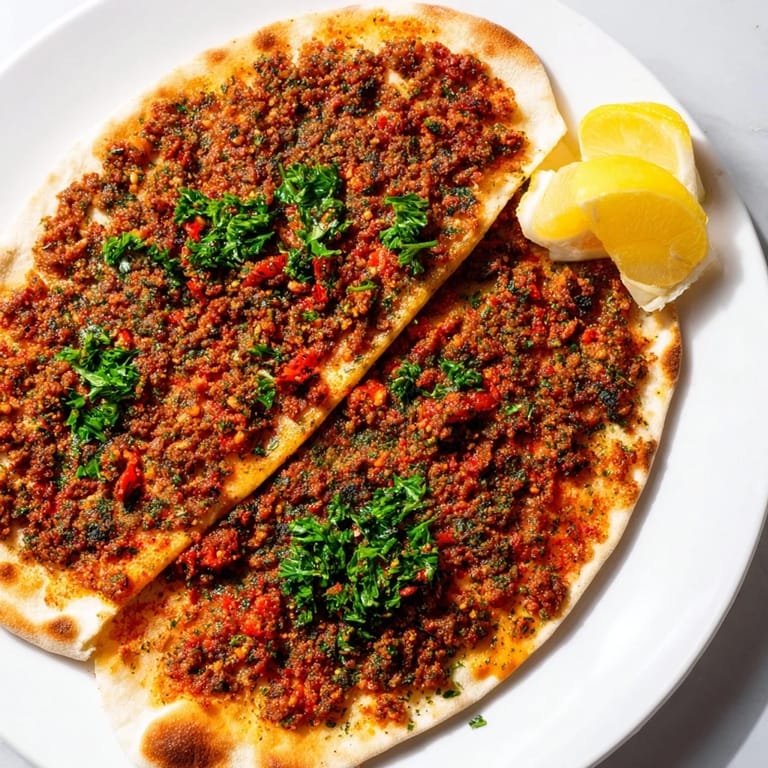
Lahmacun is meant to be interactive—it's as much about how you eat it as what you eat. The traditional way is to squeeze lemon juice over it and roll it up with fresh herbs, sliced onions, and sometimes a few pickle slices, turning it into a handheld parcel. Some people prefer to fold it, others tear it into pieces and build bites. I've even seen people top theirs with a dollop of yogurt or drizzle of garlic sauce. The beauty is that there's no wrong way, only your way.
- Try a vegetarian version by replacing the meat with finely minced mushrooms and toasted walnuts for earthiness.
- Make it a day ahead and reheat gently in a moderate oven to restore crispness without drying everything out.
- Serve with ayran (Turkish yogurt drink) or a chilled white wine for a meal that feels complete and balanced.
 Save to Pinterest
 Every time I make lahmacun, I'm reminded that some of the best food comes from simplicity—good flour, good meat, fresh vegetables, and the willingness to spend a little time with your hands in the dough. It's Turkish home cooking at its finest, and now it can be yours too.
Questions & Answers
- → What type of meat is used for the topping?
Ground lamb or beef is combined with spices and fresh vegetables to create the topping.
- → How should the dough be prepared for best results?
The dough is kneaded until smooth, allowed to rise until doubled, then rolled very thin for a crisp texture.
- → What oven temperature is ideal for cooking?
Baking at a high temperature around 250°C (480°F) ensures the dough crisps quickly and toppings cook evenly.
- → Can this flatbread be served with accompaniments?
Yes, it pairs well with lemon wedges, fresh herbs, sliced onions, sumac, and traditional drinks like ayran.
- → Is there a vegetarian alternative for the topping?
A minced mixture of mushrooms and walnuts can replace the meat for a vegetarian version.